|
|
|
March 3, 2005
IEEE-GRSS Distinguished Lecture Series
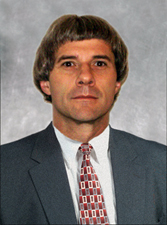
Dr. Scott Hensley, Radar Engineer
NASA Jet Propulsion Laboratory
"Mapping the World’s Topography from
Space –
The Shuttle Radar Topography Mission"
229 Dixon Hall, Elizabeth City State University

|
2:00 - 3:30 Registration and Poster Session
3:30 - 4:30 Lecture
4:30 - 5:30 NE North Carolina Chapter of the IEEE Geoscience and Remote Sensing Society (GRSS)
5:30 - 6:30 Reception
|
Mapping
the World’s Topography from Space – The Shuttle
Radar Topography Mission
Scott Hensley
Jet Propulsion Laboratory Abstract
A
highly accurate global topographic map of the Earth’s
surface has been an elusive goal for at least three decades
that will soon be achieved with the newly acquired Shuttle
Radar Topographic Mission (SRTM) data. The National Aeronautics
and Space Administration (NASA) in conjunction with the National
Imagery and Mapping Agency (NIMA) of the US developed SRTM
to meet this critical mapping requirement. SRTM collected
data for 99.97% of the Earth’s landmass between –57°
and 60° latitude during an 11 day mission in February
2000. A modified version of the SIR-C radar that previously
flew on the shuttle in 1994 augmented with a radar mounted
on a 62 m boom was used to collect radar interferometric data
at C (5.6 cm wavelength) and X (3 cm wavelength) bands. The
C-band radar was operated in the SCANSAR mode in order to
extend the swath width to 225 km, the minimal amount required
to achieve contiguous coverage at the equator. By combining
the data from both ascending and descending orbits a seamless
mosaic of the Earth’s topography will be created. This
talk will present a mission overview, how the data was collected
and being processed, and show some examples of SRTM data and
how it may be used.
|
Dr.
ScottHensley
NASA Jet Propulsion Laboratory
Dr.
Scott Hensley received his BS degrees in Mathematics and Physics
from the University of California at Irvine and his Ph.D.
in Mathematics from the State University of New York at Stony
Brook where he specialized in the study of differential geometry.
Subsequent to graduating, Dr. Hensley worked at Hughes Aircraft
Company on a variety of radar systems, including the Magellan
radar. In 1992, Dr. Hensley joined the staff of the Jet Propulsion
Laboratory where he studies advanced radar techniques for
geophysical applications. His research has involved using
both stereo and interferometric data acquired by the Magellan
spacecraft at Venus. Dr. Hensley has worked with ERS-1, JERS-1
and SIR-C data for differential interferometry studies of
earthquakes and volcanoes. Current research also includes
studying the amount of penetration into the vegetation canopy
using simultaneous L and C band TOPSAR measurements and repeat
pass airborne interferometry data collected at lower frequencies.
He is the GeoSAR Project Manager and is currently leading
the GeoSAR Processing and Algorithm Development Team for an
airborne interferometric radar mapping instrument using X
and P-bands for mapping true ground surface heights beneath
the vegetation canopy. He is the technical lead of the SRTM
Interferometric Processor Development Team that is a shuttle
based interferometric radar used to map the Earth’s
topography between ±60° latitude. |
| |
Contact
(252) 335-3696 for more information.
Geoscience
and Remote Sensing Society
http://ewh.ieee.org/soc/grss/meetings.html
Maps/Hotels/Directions |
|
|